This post contains Amazon affiliate links. As an Amazon Associate I earn from qualifying purchases.
Disclaimer: While this post aims to provide informative insights, it’s important to note that I am not a doctor, dermatologist, or medical esthetician. For personalized skincare advice, it’s always best to consult a licensed medical professional, ensuring you make informed decisions about your skincare routine.
I started getting monthly jelly mask facials about a year ago as part of a membership at a local salon. My favorite part is that I don’t have to think. I show up, lie down, and zone out while someone else handles my skin for an hour.
You can also do jelly masks at home for a fraction of the cost, and they work pretty well. This post covers what jelly masks are, what they do for your skin, whether a professional facial is worth it, and how to do one yourself without making a complete mess of your bathroom.
What is a Jelly Mask Facial?

A jelly mask starts as a powder you mix with water. Once applied, it sets into a firm, rubbery layer over your face and peels off cleanly after 15 to 20 minutes.
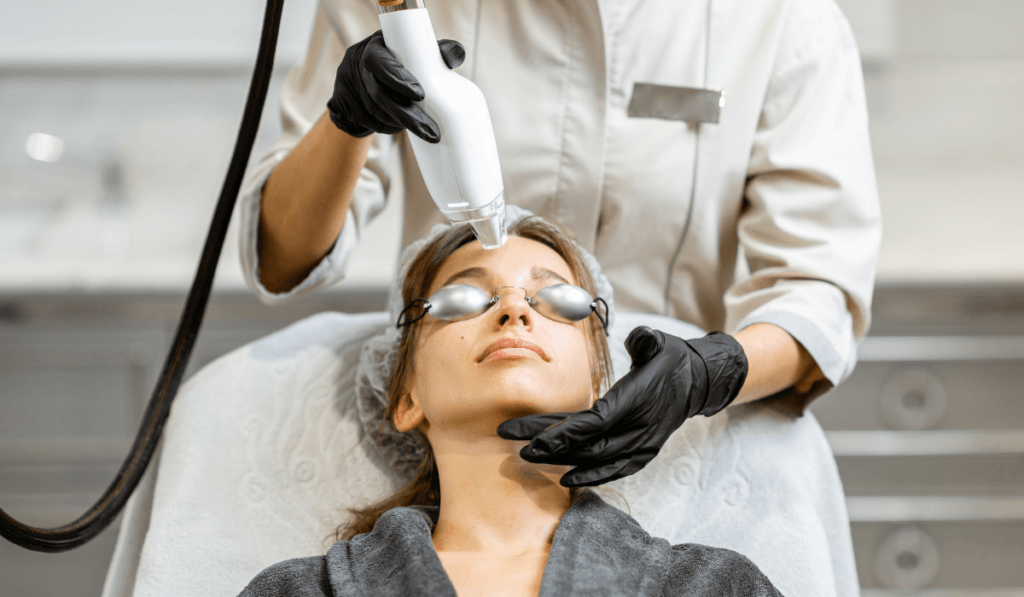
In a professional setting, the facial usually begins with a cleanse and sometimes an exfoliation step. Your esthetician mixes a mask suited to your skin concerns, applies it, and may offer a scalp or shoulder massage while it sets. Some use a facial roller over the solidified mask for a gentle lymphatic massage. After the mask comes off, serums and moisturizer finish the treatment.
First-timers sometimes wonder: yes, the mask usually covers your eyelids and mouth. Your nostrils stay uncovered. If you’re prone to feeling claustrophobic, mention it beforehand so your esthetician can adjust.
What Do Jelly Masks Do?
The gel consistency lets the mask seal against your skin, which pushes active ingredients in rather than leaving them sitting on the surface. The main gelling agent is alginate, a seaweed-derived compound also used in wound healing.
The main difference between jelly masks and sheet masks comes down to how they make contact with your skin. A sheet mask sits on top and relies on the fabric to hold ingredients against your face. A jelly mask seals directly against the skin surface, which creates a more occlusive barrier and pushes active ingredients in rather than leaving them sitting on top. You also peel it off in one piece rather than peeling away a wet sheet, which feels cleaner and tends to leave less residue.
Beyond the base, the ingredients vary by mask type. Hyaluronic acid versions focus on hydration. Charcoal and salicylic acid versions pull out impurities. Anti-inflammatory options use ingredients like aloe, calendula, or chamomile.
Jelly masks won’t give you the results of a laser treatment or chemical peel. They’re a hydration and maintenance treatment, not a correction tool. If you have active broken skin or open acne lesions, patch-test first or wait until things calm down.
If you have sensitive skin, jelly masks are actually a reasonable option compared to more aggressive treatments. The alginate base is gentle, and there are several formulations made specifically for reactive skin. Calendula and Chamomile are the most straightforward picks as both are anti-inflammatory and well-tolerated. Aloe Vera works well for post-irritation recovery. Red Gold (Lactic Acid) is worth considering if you want some anti-aging benefit without the harshness of glycolic acid. All four are in the category guide below.
Is a Professional Jelly Mask Facial Worth It?

If it fits your budget, yes. You’re paying for the experience: someone else applying and removing the mask, the massage component, and the curated product selection. I get mine through a salon membership and it’s one of my favorite parts of the month.
It’s not essential, though. The at-home version gets you most of the skin benefits at a much lower cost, with more effort and a higher tolerance for mess.
Doing a jelly mask at home
You’ll need jelly mask powder, water, a small bowl, a spatula or brush, and optionally a facial roller.
- Double-cleanse your face first.
- Mix the powder with water until you get a thick, smooth consistency. Read the tips section below before you start.
- Apply evenly to your face.
- Relax for 15 to 20 minutes. Once the mask has set, you can run a facial roller over it.
- Peel the mask off in one piece if you can.
- Follow with moisturizer.
Once or twice a week is the right cadence for most people. More than that doesn’t get you better results. Skin needs time between sessions to absorb what you’ve put into it, and overdoing any mask can tip sensitive skin toward irritation. If your skin is on the more reactive side, start with once a week and see how it responds before adding a second session.
Tips for Your At-Home Jelly Mask Facial

Consistency. When properly mixed, jelly mask looks like thick custard or firm jello. It should hold its shape on a spatula without dripping immediately. If it runs off in a liquid stream, it needs more powder. If it’s clumpy and won’t move, it needs more water. I find it easier to start with the powder and add water a few drops at a time rather than the other way around. Once it’s too thin, you can’t fix it without adding more powder and ending up with twice as much mask as you need.
Wear a headband. Jelly masks drip and shift, and they get in your hair. A washable headband is the most useful piece of advice I can give you. I learned this the hard way.
Apply slightly thicker at the edges so the whole thing peels off in one piece.
Lie down and don’t talk. The mask sets better if you stay still. Use the time for a hair mask, a foot mask, or just your phone.
Choose Your Jelly Mask!
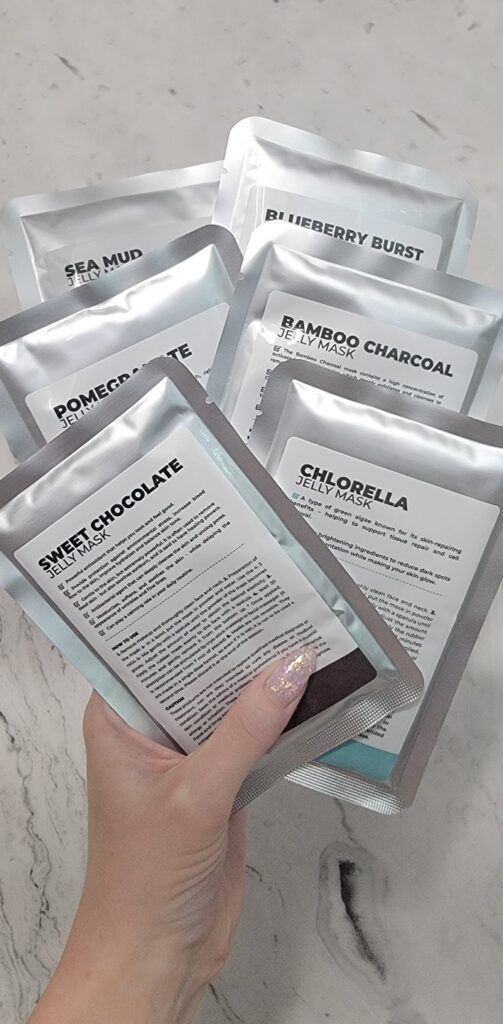
I use Bruun masks at home. They mix cleanly, the instructions are clear, and there’s enough variety that I haven’t gotten bored. Start with a sample kit before committing to a full jar.
Bruun 30-piece Jelly Mask Kit – best value. All 24 mask types with some duplicates, 30 masks total.
Bruun Neo Jelly Mask Kit – a mix of hydration, anti-aging, and skin rejuvenation masks.
Bruun Hydrating Jelly Mask Kit – focused on moisture and plumpness. Good starting point if dryness is your main concern.
Bruun Exfoliating Jelly Mask Kit – targets cell turnover and uneven texture.
Bruun Jelly Masks By Category
1. Hydrating and Moisturizing
- Avocado: Highly moisturizing. Ideal for dry skin.
- Chamomile: Hydrating. Softens skin.
- Chlorella: Highly hydrating with antioxidants.
- Chocolate: Highly hydrating and promotes a balanced lipid layer.
- Hyaluronic Acid: Increases skin’s hydration, giving the skin a plumping and lifting effect.
- Kiwi: Hydrating. Promotes cell regeneration and collagen reinforcement.
2. Anti-inflammatory and Healing
- Aloe Vera: Super healing, anti-inflammatory, tissue regenerating.
- Blue Lavender: Anti-inflammatory and soothing. Helps to relax and relieve stress.
- Calendula: Regenerating, anti-inflammatory, healing. Ideal for sensitive skin.
- Chamomile: Improves swollen skin. Reduces dark circles and redness.
- Chlorella: Soothing with antioxidants.
- Egyptian Rose: Soothes and softens the skin.
- Jasmine: Anti-inflammatory. Helps you relax and relieve stress.
- Peppermint: Boosts blood circulation. Eliminates dark circles, bags, and redness.
- Pomegranate: Soothes inflamed skin and works to reduce the appearance of acne scars.
- Tea Tree: Soothes irritated skin.
3. Detoxification and Cleansing
- Black Gold (Salicylic Acid): Charcoal removes impurities and dead skin; salicylic acid targets blackheads.
- Charcoal Bamboo: Removes toxins and dead skin cells.
- Sea Mud: Absorbs skin impurities and toxins.
4. Anti-Aging and Firming
- 24K Gold (Mandelic Acid): The mandelic acid removes dead cells to reduce fine lines and even skin tone. Stimulates collagen and elastin production.
- Chlorella: Helps improve skin firmness and elasticity.
- Egyptian Rose: Good for mature skin.
- Kiwi: Promotes cell regeneration and collagen reinforcement.
- Lavender: Regenerating, prevents wrinkles.
- Matcha: Promotes cell regeneration, fights fine lines and wrinkles.
- Red Gold (Lactic Acid): Gentle enough for sensitive skin; reduces fine lines and has a strong moisturizing effect.
- Silver Gold (Glycolic Acid): Promotes skin renewal and smooths rough texture. Works for all skin types.
5. Brightening
- 24K Gold (Mandelic Acid): The gold reduces dark spots and improves pigmentation.
- Blueberry: Reduces dark circles and post-acne marks.
- Matcha: Smooths the skin and improves pigmentation.
6. Acne
- Black Gold (Salicylic Acid): The salicylic acid renews cells, prevents blackheads, and moisturizes the skin.
- Egyptian Rose: Antimicrobial, minimizes the appearance of pores.
- Lavender: Deeply cleanses to fight acne.
- Pomegranate: Prevents and fights acne. Balances oil production.
- Sea Mud: Fights blemishes.
- Tea Tree: Antimicrobial properties.
Which masks are you most interested in trying? Drop it in the comments.